Rapid Prototyping Service: From CAD File to a Real Part in Days
You draw a part. We print it. You hold it in a few days, test it, and print the next try. No mold, no setup fee, no minimum order.
Made in the USAMost orders ship in 3 to 5 business daysPrice online in seconds
What is a rapid prototyping service?
A rapid prototyping service is a shop that makes one or a few test parts straight from your 3D file, with no mold to pay for first. You send the file. We print the part. Most orders ship in 3 to 5 business days.
The word rapid points at the loop, not one print. You test the part. You find the flaw. You fix the file and print it again. Most teams land on a good part in three to six tries.
We run FDM only. That means melted plastic laid down in thin lines. It is the cheapest way to hold a real, working part this week. New to these words? Our 3D printing glossary spells each one out in plain English.
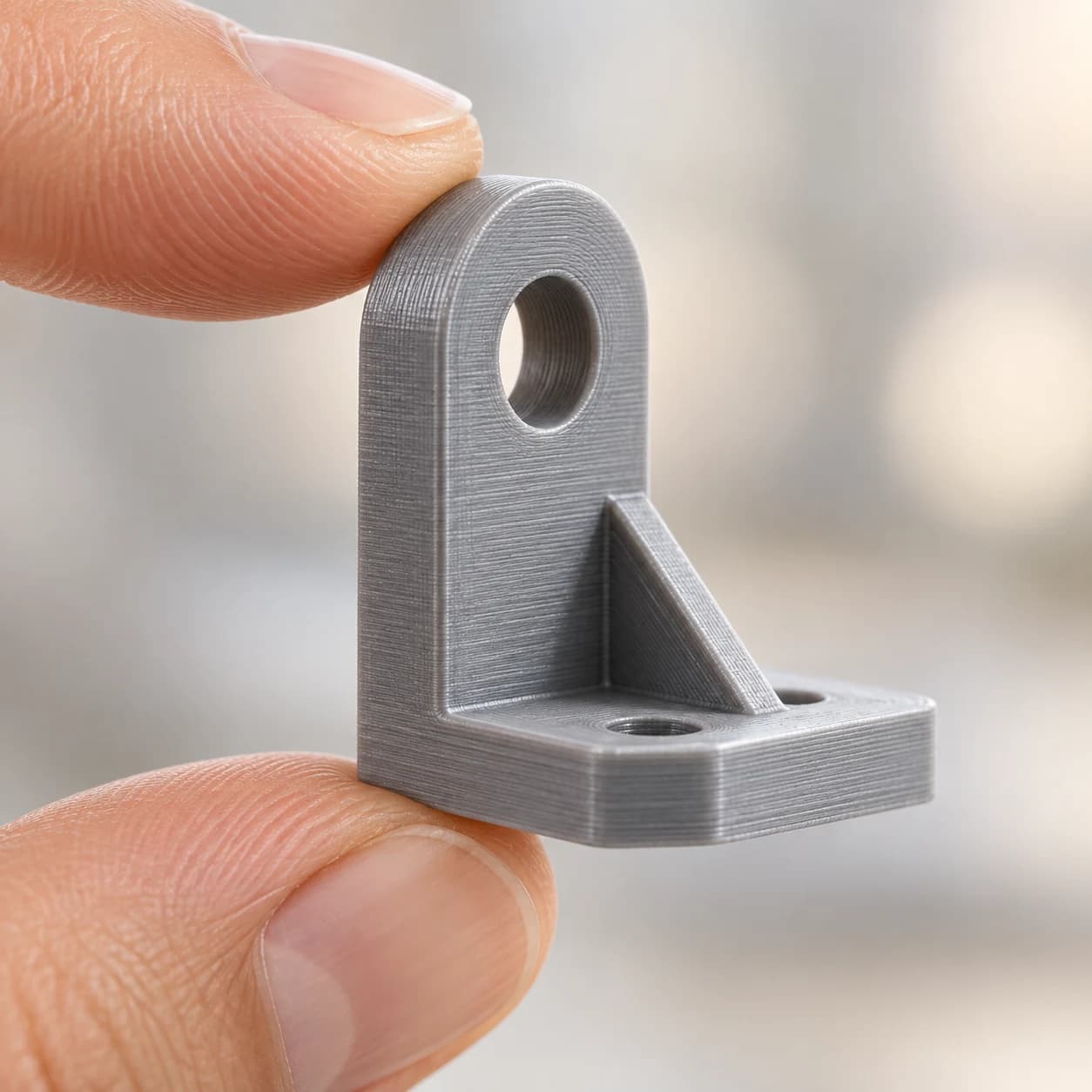
How fast can you get a prototype back?
Most prototypes ship in 3 to 5 business days. Upload an STL, STEP, or 3MF in PLA, PETG, PETG-CF or OPM and the price shows up right away. Approve it and the part goes into the queue that day.
ABS, PA-CF, and TPU take a different path. A person prices those. A person reviews your request and follows up by email.
Every part is made in the USA and ships inside the country. No customs. No time zone gap. No waiting on a shop half a world away to open for the day.
Ways to get a working prototype
Four paths lead to a test part. Each one trades speed for cost in a different way. This table compares the methods, not brands.
| Method | Typical lead time | Cost to start | Cost to iterate | Best for |
|---|---|---|---|---|
| In-house 3D printer | Hours to days | Buy the printer and staff it | Low once you own it | Quick shape checks by a team that already prints |
| CNC prototyping | Days to weeks | Setup and program time per part | Pay setup again on each change | Metal parts and tight fits |
| Injection mold tooling | Weeks to months | Ten thousand dollars and up for the tool | A tool change costs more time and money | A locked design at very high counts |
| Outsourced FDM printing (us) | Most orders, 3 to 5 business days | No tooling, no setup fee | Just the part price again | Working plastic parts, 1 to 10,000 |
An in-house printer wins on speed for a rough shape check. It loses when you need a plastic your machine cannot run, a part bigger than your bed, or ten copies while your one printer is busy. Sending the job out frees the machine you own for the jobs it is good at.
What does it cost to print version two?
Version two costs about what version one cost. There is no setup fee to pay twice and no tool to re-cut. That is the whole reason teams iterate on printed parts.
You pay one flat price per part. It covers the material, the print, and packing. Shipping is a separate flat line, shown before you pay. Added work, like heat-set inserts, shows up as its own line.
Order more and the price per part drops. The steps are 1 to 9, 10 to 49, 50 to 249, 250 to 999, and 1,000 and up. Your price holds for 30 days, so a PO has time to clear. Read how our pricing works, or upload a file for a real number at the instant quote.
What do you need to send us?
Send a 3D file. STL, 3MF, STEP and OBJ get an instant price. Anything we cannot read goes to a person for a quote. A person reviews your request and follows up by email.
An STL is a triangle skin of your part. A 3MF carries the units too, so the size lands right the first time. Either one works fine for a prototype.
No CAD file at all? Send a drawing or a sample part. We build the printable file. The design work is quoted as its own line, and the print is a separate line. See custom parts for how that works.
Tell us three things in the notes. Which way the part gets loaded. Which sizes have to be tight. What hardware bolts to it. We aim the layers at the load and size the holes to match your screws.
Can you prototype in the production material?
Yes. Print the test part in the same plastic the final part will use. The way it behaves carries over, so you do not re-test the design when you scale up.
That matters because plastics do not act alike. PETG ranks high for shape well in normal heat. PLA costs less, but has the lowest heat tolerance of our five core materials. ABS ranks second for heat, behind only PA-CF. PA-CF holds the most heat we print. TPU bends instead of breaking. These heat calls are rankings across the materials we sell, not published specs, since filament brands differ widely on the same nominal material.
Use PLA when you only need to check shape and fit. It is cheap and prints clean detail. Move to PETG or PA-CF the moment the part has to take load or heat. Full specs sit on the materials page.
Where FDM prototypes fall short
FDM is not right for every prototype. Here is where it loses, so you do not waste a week finding out.
We do not print metal and we do not cast. Clear parts are out too. A part that must be see-through belongs with a resin or a machining shop.
Size caps at 256 mm on a side. A bigger part gets split into pieces that bolt together.
Plan on holding size to about plus or minus 0.5 percent, with a floor near half a millimeter. That is typical, not a promise. A press fit needs one test part before you order the rest.
You will see layer lines. We do not sand or paint, so plan on the part looking printed. Walls under about 1.6 mm read as weak, and features under 1.2 mm may not print at all. Our 7 design checks flag both before you pay.
How teams use a rapid prototyping service
These examples show typical jobs, not named customers.
A hardware team prints v1 of a sensor housing in PLA on Monday. The mount hole sits 2 mm off. They shift the hole and print v2 the same week, then move to PETG for the parts that go in the field.
A plant engineer prints one PETG guard to check clearance on a line. It fits, so the same file goes back for a run of 60. Nothing gets redrawn and no new vendor is needed. That is the handoff our low-volume production page covers.
A founder prints six cases in a row over three weeks, each with a small change. The file stays on the account, so version six sits next to version one when the team reviews the history. Want the design side of this loop? Read our guide to 3D printing a prototype.
Common questions
- What does rapid prototyping mean?
- Rapid prototyping means making a test part fast, straight from a 3D file, with no mold or tooling first. You print a version, test it, change the file, and print again. The point is the loop, not one print. Most FDM prototypes ship in 3 to 5 business days.
- What are the advantages of rapid prototyping?
- You find design problems while they are still cheap to fix. There is no tooling bill, no minimum order, and no setup fee to pay twice. You hold a real part in days instead of weeks. And you can test in the same plastic the final part will use.
- What methods are used in rapid prototyping?
- Four methods come up most. FDM melts plastic into thin lines. SLA cures liquid resin with light. SLS fuses nylon powder. CNC machining cuts the shape out of a solid block. We run FDM only. It is the best fit for working plastic parts you plan to load, bolt, or drop.
- How is a rapid prototyping service different from a one-off 3D print?
- A one-off print is one part. A service carries the whole loop. We check the file for print problems, price it, print it, and keep the file on your private order page. When the design is done, you order the production run from the same seller in the same plastic. You never switch vendors.
- Can you prototype in the same material the final production part will use?
- Yes. If the final part needs PETG, prototype in PETG. If it needs PA-CF, prototype in PA-CF. The way the part behaves carries over from the sample to the run. PA-CF holds the most heat of anything we print and PETG ranks well behind it, so pick by the heat and load your part will really see.
Last reviewed 5 September 2026 by 3D Printer on Demand.
See your price in the next 60 seconds.
Upload your STL. Made in the USA, shipped in days.