3D Printed Jigs and Fixtures: Custom Shop Tooling in Days, Not Weeks
A jig guides a tool. A fixture holds a part. We print both to fit your job, in PETG or PA-CF. No tooling bill, no minimum order.
Made in the USAMost orders ship in 3 to 5 business daysPrice online in seconds
What are 3D printed jigs and fixtures?
A 3D printed jig or fixture is a custom shop tool built up in plastic layers instead of cut from metal. It does the same job the machined one did. It just costs less and arrives in days.
A jig guides a tool. A drill jig points the bit at the same spot every time. A fixture holds the part still while you cut, glue, sand, or test it. Plenty of shop tools do both jobs at once, so do not get stuck on the label.
We print them in PETG and PA-CF. Send a CAD file, a drawing, or the part the tool has to hold. A person quotes the lead time and gives you a date before you pay.
This page covers the buying side: cost, lead time, material, and how to send us a job. For the design side, read our guide to 3D printed jigs and fixtures.
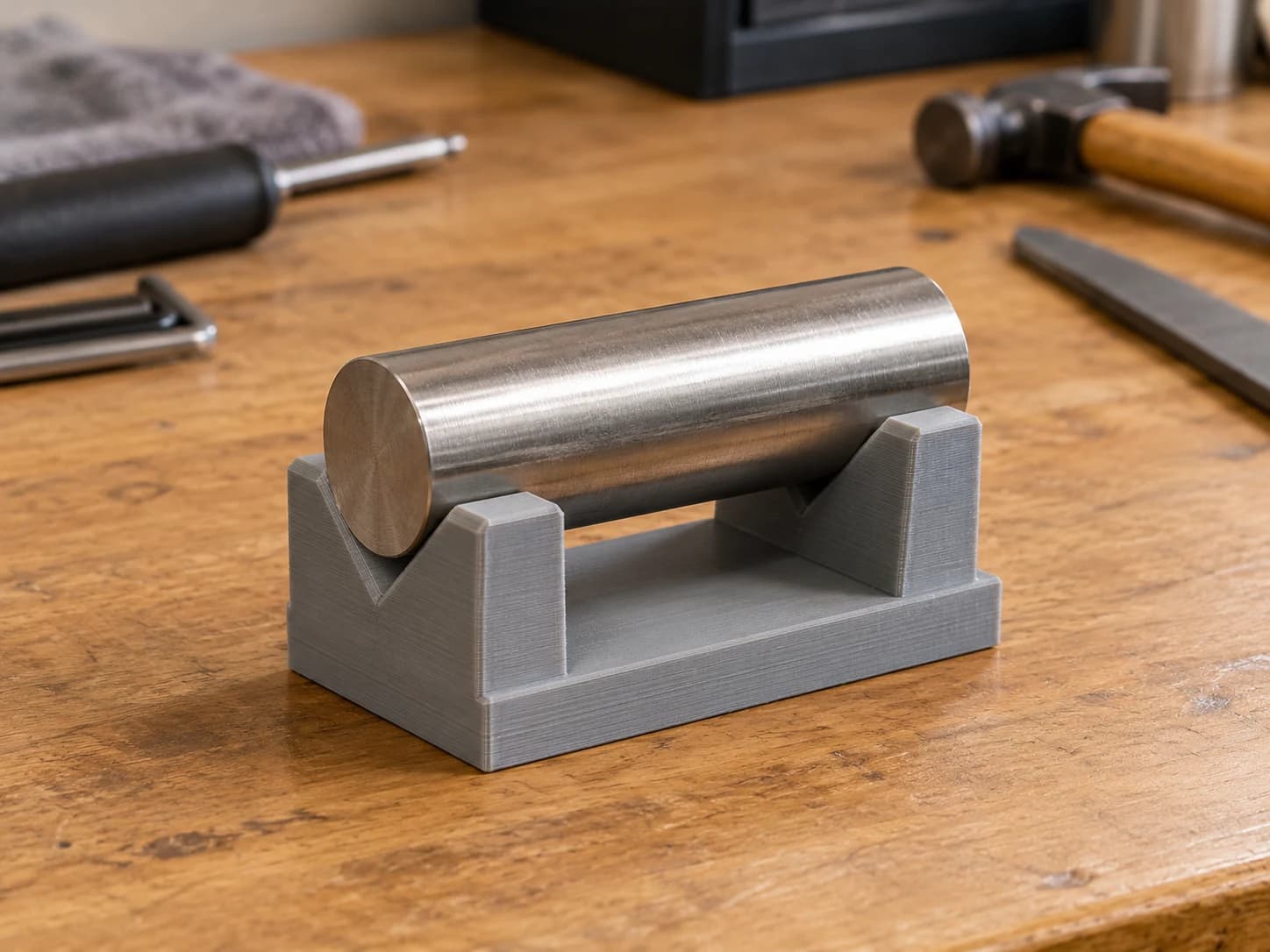
Material picks for jigs and fixtures
PETG covers most jigs. Move up to PA-CF when the tool takes a beating or sits under load all shift. Here is the whole set side by side.
| Material | Heat, ranked | Typical use |
|---|---|---|
| PETG | Lower | General shop jigs, drill guides, part nests |
| PLA | Lowest | Light indoor use and quick fit checks only |
| ABS | High | Jigs that sit near heat |
| PA-CF | Highest | Heavy load, high wear, clamped every shift |
Watch the heat column on a shop floor. PLA has the lowest heat tolerance of the four, which is easy to hit next to a hot tool or a lamp. PETG buys you more room. PA-CF holds the most heat and is our pick for jigs under real load. These are rankings across the materials we sell, not published specs, since filament brands differ widely on the same nominal material. See the full materials page for the full comparison.
How fast can you get a custom fixture?
Larger runs order online at the per-part price for that quantity, or go to a person for review. On a reviewed run, a person quotes the lead time and gives you a date before you pay. Expedited production is a request. A person emails you a price and a date before anything starts.
A single test jig moves faster. Most orders of one to ten parts ship in 3 to 5 business days. Check the fit first, then order the set for every station.
PETG and PLA get an instant price the moment you upload. PA-CF goes to a person, who prices it. A person reviews your request and follows up by email. Every part is made in the USA and ships inside the country.
What does a custom jig cost?
You pay one flat price per jig. There is no tooling bill, no setup fee, and no minimum order. A shop that machines the same tool charges for setup and program time before the first chip flies.
Size and material drive most of the number. A small PETG drill guide sits at the low end. A big PA-CF nest costs more, since it uses more plastic and more machine time.
Order a set and each one costs less. The steps are 1 to 9, 10 to 49, 50 to 249, 250 to 999, and 1,000 and up. Your instant price holds for 30 days, so a PO has time to clear. A reviewed PA-CF quote shows its own valid-until date.
For a real number, upload the file at the instant quote, or read how our pricing works first.
How closely can a printed jig hold size?
Plan on about plus or minus 0.5 percent, with a floor near half a millimeter. That is typical for FDM, not a promise. We will not claim a number we cannot hold on every part.
Here is what that means in real terms. On a 100 mm jig, the drift is about half a millimeter. On a 20 mm feature, the floor rules, so it is still about half a millimeter.
That is fine for a part nest, a stop block, or a drill guide with a steel bushing pressed in. It is not fine for a slip fit you have not tested yet.
Two habits fix most of it. Flag the two or three sizes that really matter, and we hold those closest. Then print one test jig before the set.
Holes tend to print a touch small. Add clearance, or plan to ream them after. Our 7 design checks flag thin walls and small features before you pay. The glossary explains tolerance in plain words.
Can you work from a drawing or a sample part?
Yes. A CAD file is the easy path, but it is not required. Most shops that need a jig do not have one drawn yet.
Send a drawing and we build the printable file. The design work is quoted as its own line, and the print is a separate line.
Send the part the jig has to hold, or a photo with rough sizes, and we will measure and model it. Most tools built this way print in PETG or PA-CF. See custom parts for how that step runs.
Tell us three things with the job. Which part the tool grabs. Where the load or the clamp pushes. Which hardware bolts to it. We aim the layers at the load and size the holes for your screws.
When a machined jig is still the right call
Printed plastic does not replace every shop tool. Here is where it loses, so you do not learn it the hard way on the floor.
Use metal for weld fixtures. Plastic will not survive the spatter or the heat.
Use metal when a cutter can touch the tool, or when a clamp bites hard right on the jig body. Plastic gives under a steel clamp and the part shifts.
Press a steel bushing into a printed drill guide. Bare plastic wears out fast under a spinning bit.
Size caps at 256 mm on a side. A bigger tool splits into pieces that bolt together.
How shops order jigs and fixtures
These examples show typical jobs, not named customers.
An assembly line needs a nest that holds one housing while screws go in. One PETG test part proves the fit. Then 24 more ship for the other stations.
A maintenance team prints a PA-CF drill guide for a repair that repeats each quarter. The file stays on the account, so the next one takes a click. That is the same flow our plant operations page walks through.
A shop stocks 30 small fixtures, 20 units each. No tool gets machined and no setup gets paid, so the whole set prints in one order. That is a low-volume production job wearing a different hat.
Common questions
- What is the difference between a jig and a fixture?
- A jig guides a tool. A fixture holds a part. A drill jig aims the bit at the right spot. A fixture clamps the part so it cannot move while you work on it. Plenty of shop tools do both at once, so the job matters more than the label.
- How much does a custom jig or fixture cost?
- You pay one flat price per jig, set by its size and its plastic. There is no tooling bill, no setup fee, and no minimum order. Order a set and the price per jig drops at each volume step. Upload the file for a real number. Or ask for a review. A person reviews your request and follows up by email.
- What material should I use for a jig that sees heavy wear?
- PA-CF. It is carbon fiber nylon and it holds the most heat of anything we print. Use it for jigs that get clamped every shift or take real load. PETG is the better value for general shop work.
- How fast can you turn around a custom fixture?
- Larger runs order online at the per-part price for that quantity, or go to a person for review. On a reviewed run, a person quotes the lead time and gives you a date before you pay. Expedited production is a request. A person emails you a price and a date before anything starts. Most single test fixtures ship in 3 to 5 business days. PETG and PLA get an instant price on upload, and PA-CF is priced by a person. A person reviews your request and follows up by email.
- Can you design a jig from a drawing or a sample part, not just a CAD file?
- Yes. Send a drawing and we build the printable file. The design work is quoted as its own line, and the print is a separate line. Or send the part the jig has to hold, or a photo with rough sizes, and we will measure and model it. Most tools built this way print in PETG or PA-CF.
- How accurate are 3D printed jigs and fixtures?
- Plan on about plus or minus 0.5 percent, with a floor near half a millimeter. That is typical for FDM, not a promise. On a 100 mm jig the drift is about half a millimeter. Flag the two or three sizes that matter most and we hold those closest, then print one test jig before the full set.
Last reviewed 5 September 2026 by 3D Printer on Demand.
See your price in the next 60 seconds.
Upload your STL. Made in the USA, shipped in days.