Design Guide
The 7 Design Checks. Pass These Before You Upload.
The moment you upload an STL, we run 7 quick checks on it. Most just give advice. A few route your part to a fast human quote. Here is each one in plain words, so your part prints right the first time.
Your part fits our print bed
What we check: We measure the longest side of your part. Biggest part: 250 mm (9.8 in) on any side in PLA or PETG, 220 mm in other materials. Bigger parts need to be split.
Why it matters: A part larger than the bed cannot print in one piece on our machines.
How to pass: Keep the longest side at 250 mm or less in PLA or PETG, or 220 mm in other materials. If your part is bigger, split it into pieces, or request a review.
Nothing is too thin to print
What we check: We check the smallest dimension of your part. Anything under about 1.2 mm is flagged.
Why it matters: Features thinner than the nozzle can lay down come out weak or do not print at all.
How to pass: Make thin features at least 1.2 mm. Thicker is stronger. Tell us in the notes if a thin feature is critical.
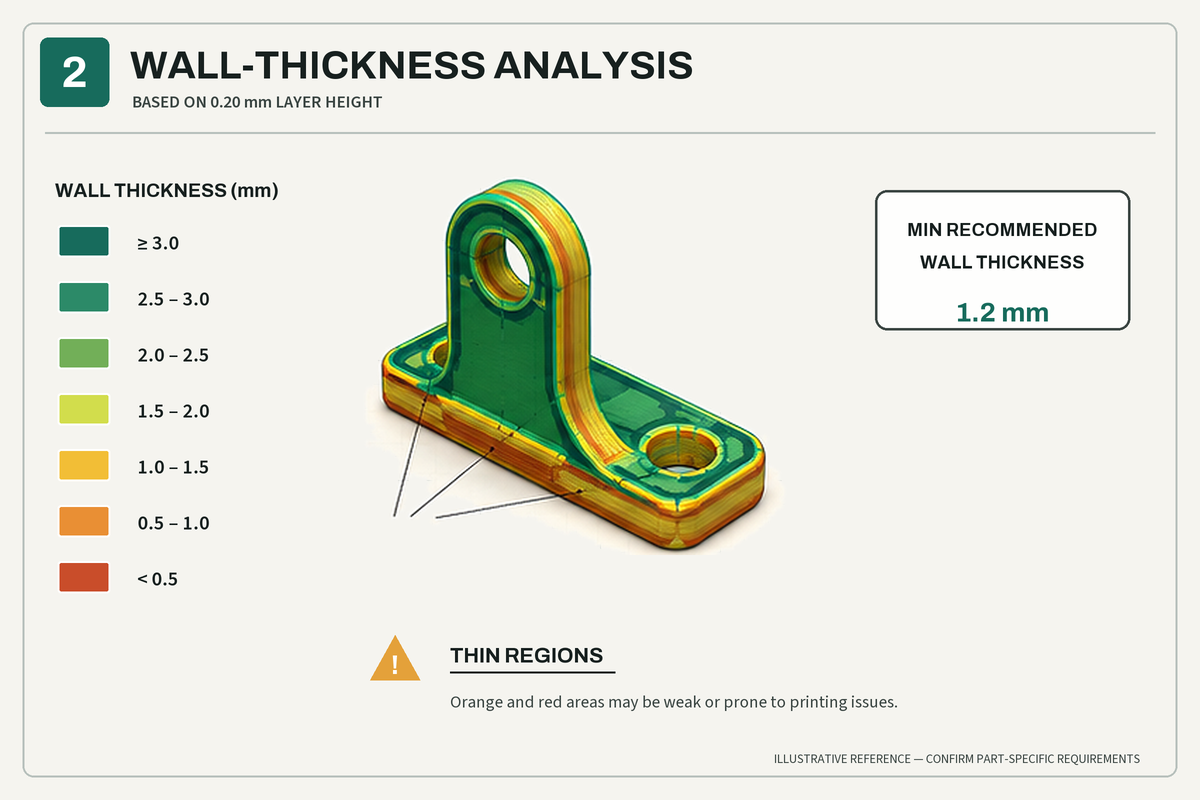
Your walls are thick enough
What we check: We estimate the average wall thickness from the model. Walls under about 1.6 mm read as fragile.
Why it matters: Thin walls can crack or feel flimsy. Two or three lines of plastic hold up much better.
How to pass: Aim for 1.6 mm walls or more where the part takes load. This is an estimate from the mesh, not a full scan.
The shape is not too long and skinny
What we check: We compare the longest side to the shortest. Very long, slender parts get flagged.
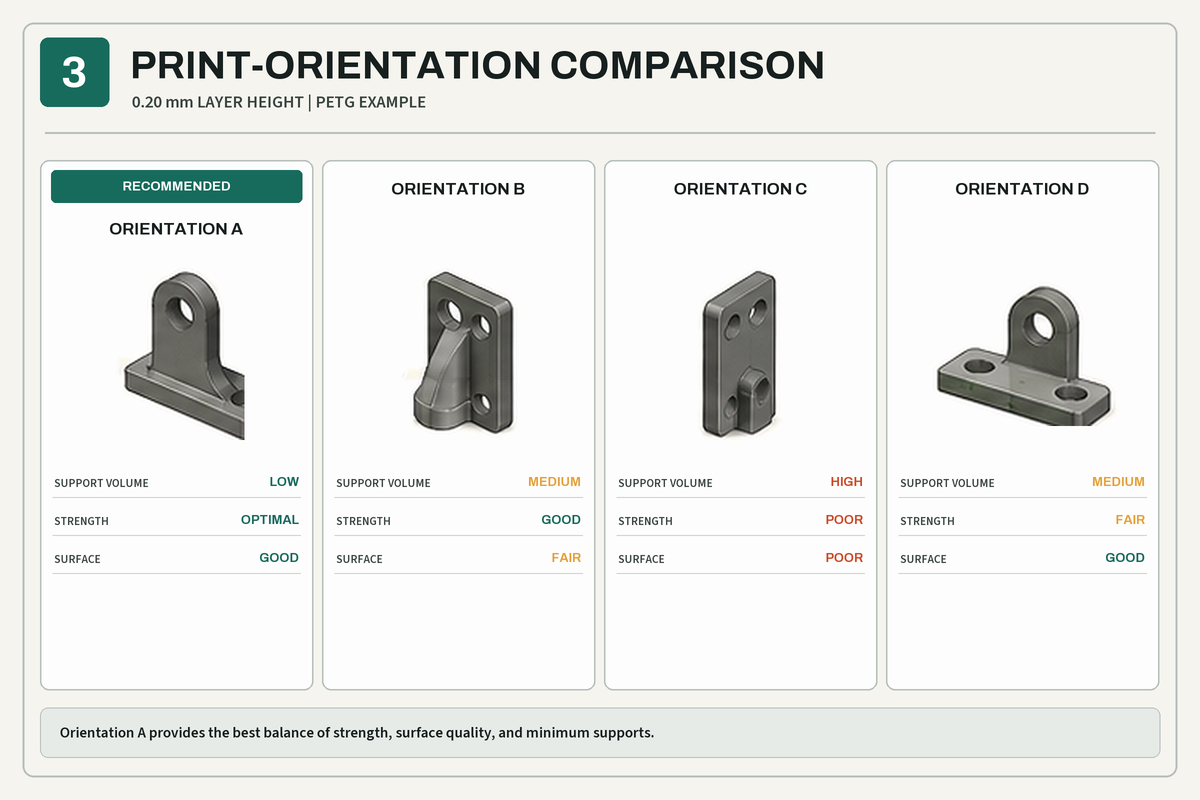
Why it matters: Tall, thin parts can bend or lift while they print. Orientation matters a lot for these.
How to pass: This one rarely blocks an order. We pick the orientation that holds the part straight. No change needed from you in most cases.
The mesh is not too heavy
What we check: We count the triangles in your file. Files over about 1.5 million triangles are flagged.
Why it matters: A very heavy mesh is slow to upload, slow to preview, and slow to slice. It still prints fine.
How to pass: Export a lighter mesh if you can. Most CAD tools let you lower the export resolution a little without losing real detail.
The model is solid and watertight
What we check: We measure the volume of your part. If we cannot read a solid volume, the mesh may have holes or flipped faces.
Why it matters: A mesh with gaps confuses the slicer and can print wrong.
How to pass: Export a clean, closed mesh. Most tools have a repair or make-solid option. We can also repair it for you, just ask.
Big flat parts will hold their shape
What we check: For ABS, we flag large flat floors, since ABS likes to lift at the corners.
Why it matters: A big flat ABS part can warp while it prints. PETG holds flat better at that size.
How to pass: For a large flat part, PETG is often the safer pick. We check flatness before the part ships either way.
See the Big Three in Pictures
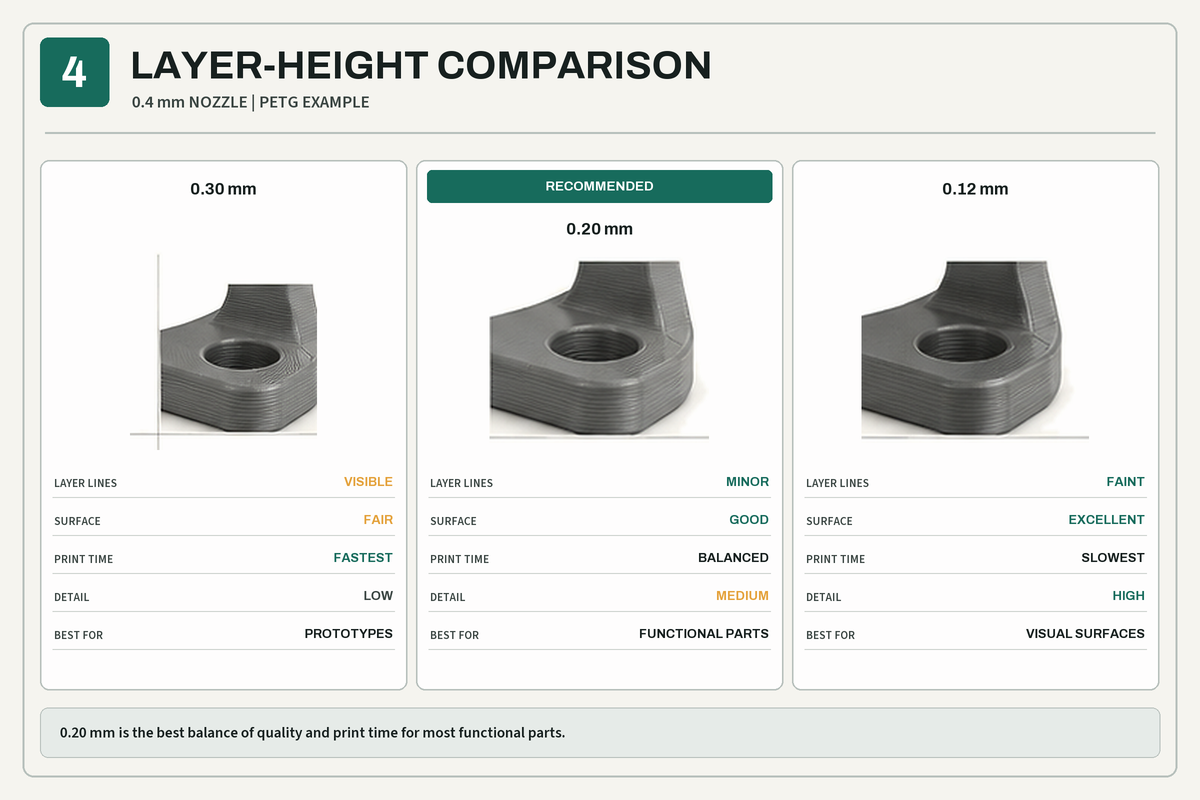
The three choices that decide most of a part's strength and finish: wall thickness, print orientation, and layer height. These reference panels use the same numbers our checks use.
Common questions
- What are the design rules for 3D printing an STL?
- Keep the longest side at 250 mm or less in PLA or PETG (220 mm in other materials), thin features at least 1.2 mm, and walls about 1.6 mm or thicker. Use a clean, watertight mesh. Big flat ABS parts can warp, so PETG is often safer at large flat sizes.
- What happens if my part fails a check?
- Most flags are just advice and your part still prints. A few, like a part larger than the bed, route to a quick human quote instead of an instant price. We tell you which one it is and how to fix it.
Ready to see your part checked and priced? It takes seconds and needs no login.
Get your instant quote