PA-CF 3D Printing: Carbon Fiber Nylon for Parts Under Load
PA-CF is nylon with chopped carbon fiber in it. It holds its shape near heat that would soften PETG, and it is our usual pick for load bearing parts.
Made in the USAShips in 3 to 5 business daysPrice online in seconds
What is PA-CF (carbon fiber nylon)?
PA-CF is nylon mixed with chopped carbon fiber. PA stands for polyamide, which is the plastics name for nylon. The tiny carbon strands add stiffness and strength to the nylon base. The result is our usual pick for load bearing parts, and it holds its shape at more heat than any other material we offer. It comes in black.
Published strength figures do not rank cleanly between our materials, so see the published material figures for what each manufacturer reports, and ask for a review if a load actually matters.
The trade-off is cost and print time. PA-CF prints slower than PETG, and the filament costs more per kilogram. You pay for the strength, so it is the right pick only when the part truly needs that strength.
How strong is PA-CF really?
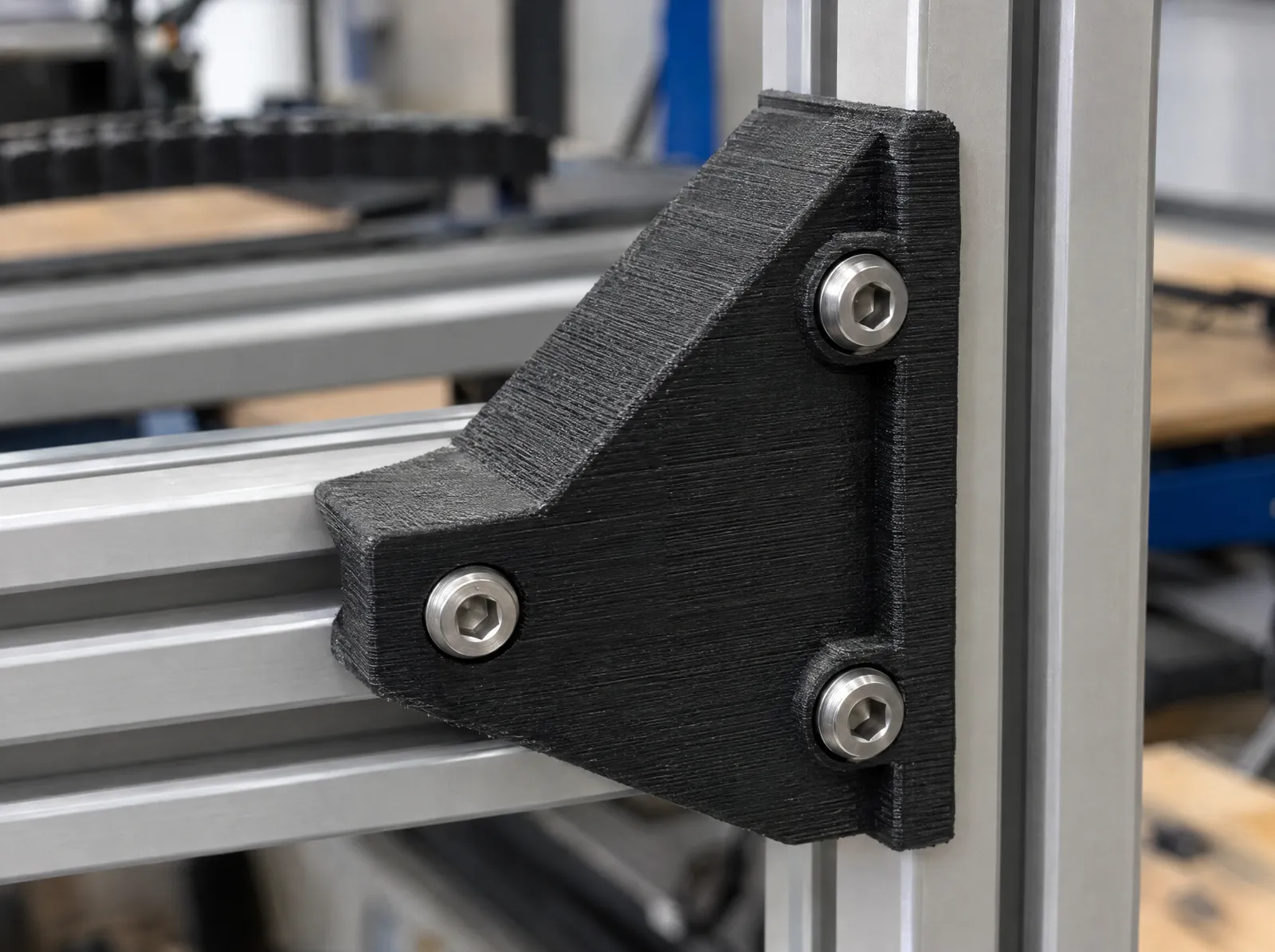
PA-CF is strong enough to replace some aluminum brackets, but only in the right direction. It is our usual pick for load bearing parts, well above PETG and ABS. It also holds its shape at the highest heat of our five core materials, well ahead of PETG. That heat headroom is why it holds tolerance near motors and hot tools.
There is a catch every engineer should know. A printed part is usually strongest along the print lines and weaker between them. PA-CF is very stiff along the fibers, but a load pulling the layers apart can still split the part. We orient the part so the fibers run the way the load runs, so that the strength lands where you need it. Tell us how the part gets loaded and we set the print up to match.
When is PA-CF worth it over PETG?
PA-CF is worth it when the part carries real load, holds tight tolerance under stress, or sits near heat that would soften PETG. If PETG already does the job, PA-CF is not worth the extra cost. PETG is tough, cheap, and gets an instant price, so it wins for most general parts.
Pick PA-CF for structural brackets, end-of-arm tooling on robots, drone frames, and jigs that must not flex under load. Pick PETG when strength is enough and budget matters. See the full trade-off on the materials guide. We print a lot of PA-CF for robotics shops and hardware teams building structural parts.
What should you watch for when designing PA-CF parts?
Watch three things with PA-CF: brittleness, moisture, and wall thickness. The carbon fiber makes the part very stiff, but stiff parts have less give, so a thin PA-CF feature can crack where a bendy material would flex. Add a little more material where the part takes a sharp load, so that the stress spreads out instead of splitting a thin spot.
Nylon soaks up water from the air over time. We dry the filament before we print and ship parts dry. If a part sits in a damp space for months, its strength can drift a little. For most shop and indoor use, this is not a problem.
Keep walls thick enough to carry the load. Thin walls read as fragile in any material, and stiff PA-CF is less forgiving than PETG. Our checks flag walls under about 1.6 mm. See the 7 design checks before you upload so the part prints right the first time.
How do you get a PA-CF part priced?
PA-CF routes to a fast human quote, not an instant online price. Upload your STL and a person checks the file and confirms the material fits the part. A person reviews your request and follows up by email. This quick review is on purpose, since PA-CF parts are usually structural and worth a real look before we print.
Once you approve, the part ships in 3 to 5 business days. Per-part cost usually runs two to three times the PETG price for the same file, and it drops as your order grows. For a real number on your part, upload the file and request a review.
Common questions
- Is PA-CF stronger than PETG?
- It is our usual pick when a part carries real load, and it holds its shape at a higher heat than PETG, ABS, or PLA. Published strength figures do not rank cleanly between these materials, so ask for a review if a load actually matters. The trade-off is higher cost and slower print time.
- What is PA-CF used for?
- PA-CF is used for parts that carry load or sit near heat: structural brackets, end-of-arm tooling on robots, drone frames, and jigs that must hold tolerance under stress. It can replace some aluminum brackets when the load runs along the print direction.
- Does PA-CF absorb moisture?
- Yes, the nylon base absorbs water from the air over time. We dry the filament before printing and ship parts dry. For most shop and indoor use this is not a problem. A part left in a damp space for months may lose a little strength.
- Can you get an instant price for PA-CF?
- No. PA-CF routes to a fast human quote instead of an instant online price. Upload your STL and a person reviews it. A person reviews your request and follows up by email. Once you approve, the part ships in 3 to 5 business days. PLA and PETG are the materials that get an instant price.
Last reviewed 5 September 2026 by 3D Printer on Demand.
See your price in the next 60 seconds.
Upload your STL. Made in the USA, shipped in days.