High mix plastic production
10,000 Part Numbers. Not 10,000 Molds.
When your yearly volume is spread across hundreds or thousands of different shapes, the tooling and the shelf space start costing more than the parts do. That is a different problem than making a lot of one thing, and it needs a different answer.
Made in the USAShips in 3 to 5 business daysPrice online in seconds
Same 1,000,000 parts a year
Same total. Completely different manufacturing problem.
Case A
1 part number, 1,000,000 units of it
- Different shapes
- 1
- Molds to pay for
- 1
- Units carrying each mold
- 1,000,000
Mold it. This is what molding is good at.
Case B
10,000 part numbers, 100 units of each
- Different shapes
- 10,000
- Molds to pay for
- 10,000
- Units carrying each mold
- 100
Now the problem changes. This is where printing earns its place.
This is a way of thinking, not a cutoff. The right process for your part still depends on the shape, the material, the tolerance you need, and how long you plan to make it. We are happy to tell you when a mold is the better answer.
The number that fools people
Total Volume Is the Wrong Number
Ask a buyer how many parts they make and you get one number. A million a year sounds like a molding job, so that is what gets quoted. But a million parts across one shape and a million parts across ten thousand shapes are not the same business at all.
A mold is paid for once per shape. Spread that cost over a million units and it disappears into the price. Spread it over a hundred units and it is most of the price. So the question that actually matters is not how many parts you make. It is how many different shapes you make, and how much each one is asked to carry.
Printing flips the setup cost to nearly nothing. A new shape is a new file. The tenth shape costs the same to start as the first. That is the whole reason this works for high mix and stops working when your volume is concentrated.
Where the money actually goes
What a Long Parts List Really Costs You
None of these show up on the price of the part. All of them show up on your books.
One tool per shape, not one per part
A mold is bought once per shape. With 200 shapes you are buying 200 of them, and each one only has a few hundred parts to pay it back.
Minimum order sizes you did not ask for
A molder needs a big enough run to be worth the setup. So you buy 5,000 of a part you use 300 of, and the other 4,700 sit on a shelf.
Shelf space and money that cannot move
Every slow part is a bin, a line on a count sheet, and cash you cannot spend. The slowest parts are usually the ones with the biggest piles.
Design changes that cost real money
Change a molded part and you may be changing steel. Change a printed part and you change the file. That gap gets wider the more shapes you own.
Parts nobody wants to make for you
Small runs of odd shapes are the jobs shops quote high to avoid. That is exactly the work a print farm is built to absorb.
Old parts with no supplier left
The machine still runs. The part is gone and the tooling is scrapped. You need 40 a year, and nobody is cutting a new mold for that.
Screening your list
Which Parts Are Worth a Closer Look
Not every part belongs on a printer, and we would rather tell you that up front than print you something that disappoints. Here is the short version of how we sort a list.
Worth a closer look
- You use fewer than a few hundred a year of it
- It is plastic, and it is not holding a life at stake
- The shape fits in a box roughly 10 by 10 by 10 inches
- You already have a 3D file, or a real part we can measure
- The design still moves, or you expect it to
- You are stuck buying far more than you use
Probably keep it where it is
- You use tens of thousands a year and the shape is frozen
- It has to be clear, food safe, or match a molded surface exactly
- It carries a safety load, or failure hurts somebody
- It needs a plastic we do not print
- It is bigger than our build area and cannot be split
- A mold already exists, is paid for, and still works
Still deciding between the two? Walk through the print or mold comparison and calculator. It runs your own numbers and it will tell you to get a mold when a mold is right.
No hand waving
What We Can Do Today
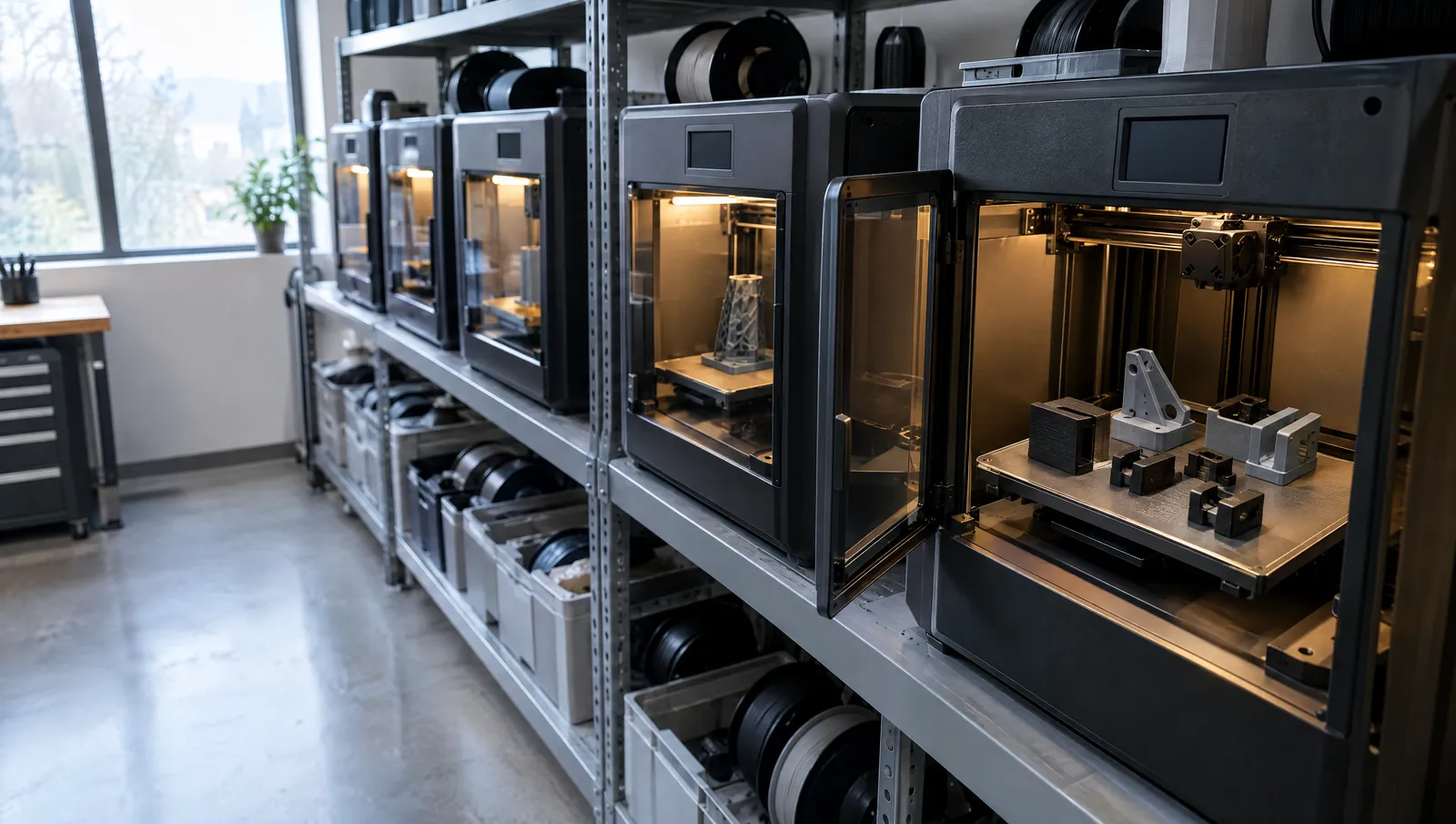
We print FDM parts in the USA. PLA, PETG, PETG-CF and OPM get an instant price online with no login. ABS for heat, PA-CF for strength, and TPU for flex get a human quote. There is no minimum order and no tooling bill, so one part and a thousand parts run off the same file at the same per part price.
You can start with a single sample, hold it in your hand, and then order the run without changing anything. Most orders ship in 3 to 5 business days. Nothing crosses a border, so there are no customs forms and no import fees.
What we are not going to pretend: we are not an inspection lab, we do not hold a certification we have not earned, and we are not going to promise you a molded surface finish. When your part needs one of those, we will say so.
The easiest place to start
Send Us Your Worst Part Numbers
Not your best ones. The annoying ones. The part you buy 5,000 of to use 300. The one with a four month lead time. The one whose supplier stopped answering. The one whose mold is worn out and cannot justify a new one.
A spreadsheet is fine. A messy spreadsheet is fine. If all you have is a list of part numbers and rough yearly usage, send that. You do not need clean data to start, and we would rather see the real list than a tidy one.
We read it and reply by email with the parts we think are worth a closer look, and the ones we think you should leave exactly where they are.
Common Questions
What is high mix, low volume manufacturing?
High mix, low volume means you make many different part numbers and only a few of each one. Engineers shorten it to HMLV. A shop that makes 10,000 copies of one part is low mix. A shop that makes 100 copies each of 200 parts is high mix, even though both make plenty of parts in total.
Why does a high part count change the math?
A mold is paid for once per shape, not once per part. If all your volume sits on one shape, that cost spreads across every unit and gets small. If your volume is spread across 200 shapes, you are buying 200 molds and each one carries very little volume. Printing has no mold, so a new shape costs nothing to set up.
How many parts do you need before it is worth talking?
There is no magic number, and any shop that gives you one is guessing. We look at how many different shapes you have, how many of each you use in a year, how often the design changes, and how much you are holding on a shelf. Send the list and we will tell you which ones look worth a closer look.
When is a mold still the better answer?
When the shape is settled, the volume is high and steady, and you plan to make the same thing for years. Molded parts also hit surface and material properties that printing cannot. We will say so. Sending you to a molder for the right part is cheaper for us than making the wrong part twice.
What can you actually print?
FDM parts in PLA and PETG at an instant online price, and ABS, PA-CF, or TPU on a quick human quote. One part up to 10,000, with no minimum order and no tooling bill. Everything is made in the USA and most orders ship in 3 to 5 business days.