Low-Volume Manufacturing: 50 to 10,000 Parts, No Mold
Bridge production between prototype and tooling. You ship real parts now, keep the design open, and pay less per part as the count grows. There is no minimum order.
Made in the USAMost orders ship in 3 to 5 business daysPrice online in seconds
What is low-volume manufacturing?
Low-volume manufacturing means making real parts in small counts, with no steel mold cut first. Think 50 parts up to a few thousand. These are not test parts. They ship to customers or go into machines.
Some shops call the same job bridge production. The name fits. You are on a bridge between a finished design and full tooling. You make real parts now while a mold gets built. Or while sales prove the part is worth a mold at all.
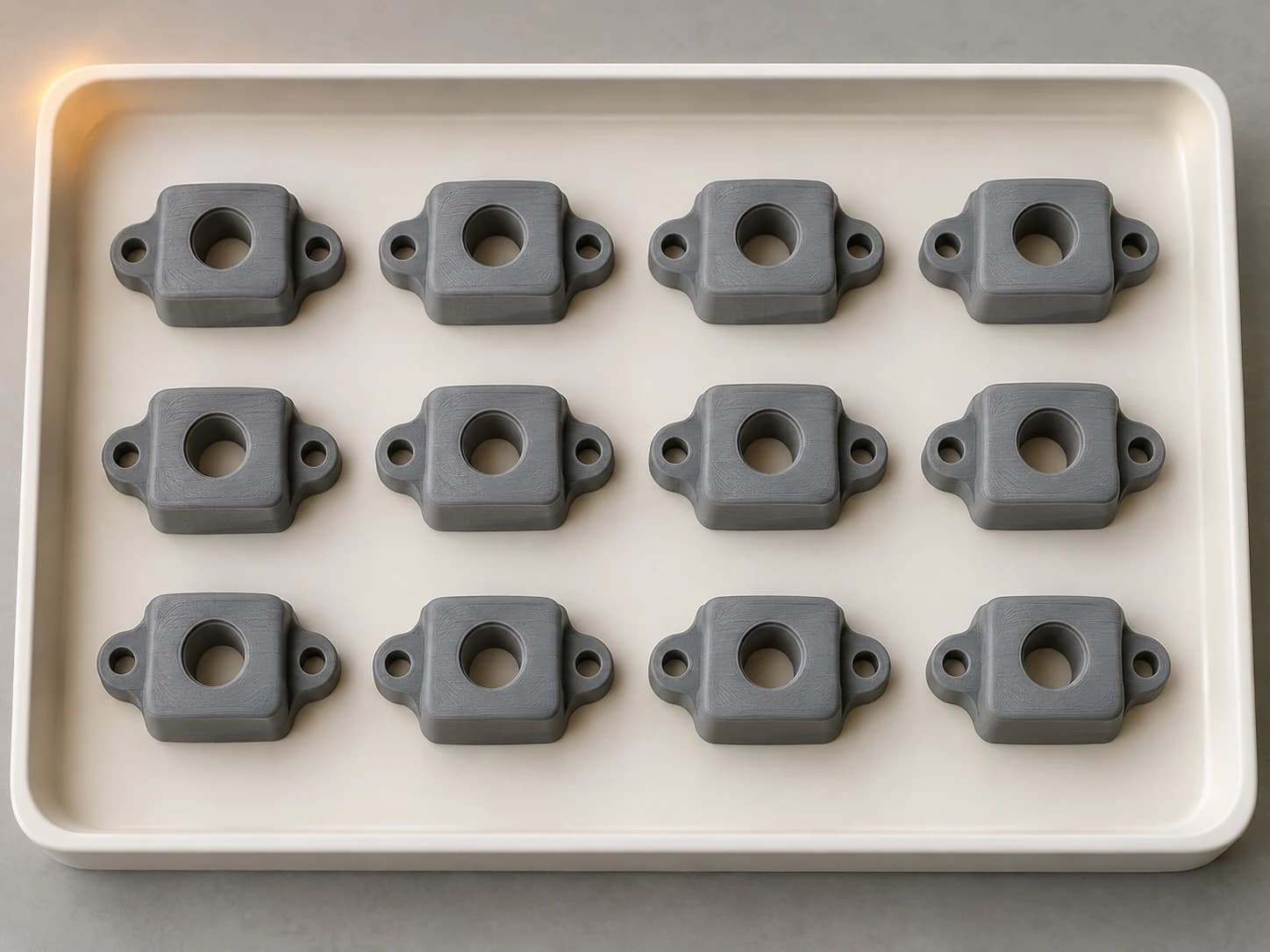
We print those runs in FDM, from 50 to 10,000 units. Every part is made in the USA. There is no tooling bill and no minimum order. The plastic and the process are the same ones that made your sample.
Engineers also call this high-mix, low-volume work, or HMLV. It means many part numbers with few of each. Printing suits that well, because a new part number costs nothing to set up.
Production paths compared
Three paths can make the same plastic part. The right one comes down to how many you need and how soon you need them. This table compares methods, not brands.
| Path | Tooling investment | Lead time to first part | Unit cost as volume grows | Best volume range |
|---|---|---|---|---|
| Injection molding | Ten thousand dollars and up for the mold | Weeks to months | Drops hard, then stays very low | Tens of thousands and up |
| CNC machining, low volume | No mold, but setup and program time per part | Days to weeks | Drops slowly | 1 to a few hundred |
| 3D printing, bridge production (us) | None | 3 to 5 business days for a sample | Drops at each volume step | 1 to 10,000 |
Read the whole row, not one cell. Molding wins on price per part, but only after the mold is paid off. Machining wins on tight fits and metal. Printing wins in the middle, where counts are small and the design may still move.
What is bridge production?
Bridge production is printing real parts to sell while a mold is being built. You ship now. You switch to molded parts later, when the tool is ready.
Tooling takes weeks or months to cut. You do not have to sit still for it. Print the first few hundred parts, get them in customer hands, and let the mold catch up.
It buys two things. First, you keep your launch date. Second, the design stays open. A late fix costs a new file here. At the molder, a late fix costs new steel and more weeks.
How long does a low-volume run take?
Larger runs order online at the per-part price for that quantity, or go to a person for review. On a reviewed run, a person quotes the lead time and gives you a date before you pay.
Expedited production is a request. A person emails you a price and a date before anything starts.
A small test batch moves faster than the run. Most orders of one to ten parts ship in 3 to 5 business days, so you can hold a sample before you commit to 500. Most buyers do that first. Our rapid prototyping page covers that step.
What drives the cost of a low-volume run?
Three things set the price: how big the part is, which plastic it uses, and how many you order. Nothing else moves it much.
We show one flat price per part. It covers the material, the print, and packing. Shipping is a separate flat line, shown before you pay. Added work, like heat-set inserts, shows up as its own line.
Order more and each part costs less. The steps are 1 to 9, 10 to 49, 50 to 249, 250 to 999, and 1,000 and up. Your instant price holds for 30 days, so a PO has time to clear. A reviewed ABS, PA-CF, or TPU quote shows its own valid-until date.
Design choices move the number too. A part with thinner walls and less infill uses less plastic and prints faster. Our 7 design checks flag the spots worth trimming. For real numbers, read how our pricing works or upload the file at the instant quote.
Which material fits a production run?
PETG is the default for most runs. It holds its shape well in normal heat. It shrugs off shop chemicals and takes a hit without cracking.
PLA is the cheap pick for indoor parts, but it has the lowest heat tolerance of our five core materials, so keep it out of hot cars and sunlight. ABS handles heat better, ranking second behind only PA-CF. PA-CF takes the most heat and is our pick for parts under real load. TPU bends and springs back. These heat calls are rankings across the materials we sell, not published specs, since filament brands differ widely on the same nominal material.
PLA, PETG, PETG-CF and OPM get an instant price on upload. ABS, PA-CF, and TPU go to a person, who prices them. A person reviews your request and follows up by email. Full comparison sits on the materials page, and PETG has a page of its own.
Reorders, stored files, and part history
Your file stays on your private order page after the first order. The next run takes a few clicks, with no new quote step.
That matters more than it sounds. A run is rarely one and done. You order 200 in spring and 300 in fall. The fall parts have to match the spring ones. Same file, same plastic, same process.
Every version stays visible, so v1 sits next to v4 when someone asks what changed. If you are not sure what a term on the quote means, our glossary defines each one in plain words.
When molding beats printing
Past roughly ten thousand of the same part per year, a mold usually wins. We will say so rather than take a job that costs you money.
Molding has a low price per part once the tool is paid off. Printing has no tool at all, so it wins under that line. Compare the total, not the per-part number. Add the tool, the wait, and the cost of one late change.
Printing is also the wrong call in three other spots. Metal parts. Parts over 256 mm on a side, unless they split into pieces. And tight fits. FDM holds size to about plus or minus 0.5 percent, with a floor near half a millimeter. That figure is typical, not a promise.
How buyers use low-volume production
These examples show typical jobs, not named customers.
A hardware brand ships its first 800 units in printed PETG while the mold gets cut. The launch date holds, and a small fix in month two costs one new file.
A plant stocks 30 part numbers at 40 units each. Each new number costs nothing to set up, so the whole set prints in one order. Many of those parts are jigs and fixtures for the line.
An OEM keeps 150 field-service covers on the shelf for a machine it stopped molding years ago. Read our production run service for volume pricing, or plant operations for the parts plants order most.
Common questions
- What is the difference between high-volume and low-volume manufacturing?
- Low volume means small counts of a part, roughly 50 to a few thousand. High volume means tens of thousands and up. The real split is tooling. Low-volume work skips the mold and stays easy to change. High-volume work pays for a mold up front, then earns it back with a low price per part.
- What counts as high-mix, low-volume manufacturing?
- High-mix, low-volume work, or HMLV, means many different part numbers with few of each. A plant with 40 spare parts and 20 units of each is a good example. Printing fits it well, because each new part number costs nothing to set up. You pay for parts, never for tooling.
- What are examples of low-volume, high-variety production?
- Spare parts for older machines. Short-run housings and brackets for a first product launch. Jigs and fixtures for a plant floor. Field-service kits. Branded covers made for one customer. Each is a small count of one part, then a new shape next month.
- What should you look for in a low-volume manufacturing partner?
- Look for four things. A real price before you commit, not a sales call. A design check that flags print problems before you pay. Stored files, so a reorder takes a click. And one seller that carries you from 10 parts to 10,000 without a switch.
- What is bridge production?
- Bridge production is printing real parts to sell while a mold is being built. Tooling takes weeks or months. Printing lets you ship and earn in the meantime. It also keeps the design open, so a late change costs a new file, not new steel.
- How long does a low-volume 3D printing run take?
- Larger runs order online at the per-part price for that quantity, or go to a person for review. On a reviewed run, a person quotes the lead time and gives you a date before you pay. Expedited production is a request. A person emails you a price and a date before anything starts. Most samples ship in 3 to 5 business days.
See your price in the next 60 seconds.
Upload your STL. Made in the USA, shipped in days.