3D Printed Brackets and Mounts: Custom Holders That Fit Your Part
A printed bracket is drawn around your part, so the bolt spacing is right the first time. One mount or a thousand, from one file.
Made in the USAMost orders ship in 3 to 5 business daysPrice online in seconds
What is a 3D printed bracket?
A 3D printed bracket is a custom mount built up layer by layer. It holds a panel, a sensor, a motor, or a run of cable in place. You draw the shape you need. We print it. There is no tooling bill and no minimum order.
Stock brackets rarely line up with an odd job. The bolt spacing is off by 4 mm. The angle is 30 degrees, not 90. A printed mount matches your part on the first try, because it was drawn around your part.
Mounts, angle brackets, clamps, standoffs, and cable holders all print the same way. For a short overview of the part type, read our guide to 3D printed brackets. This page goes deeper on load, hardware, and how to order.
How much load can a printed bracket take?
More than most people expect, but the direction of the load matters more than the plastic. A printed part is built from stacked layers. Each layer is strong along its length, and the bond between layers is usually the weaker spot.
So a bracket is strong when the load pulls along the layers. It is weaker when the load tries to peel the layers apart. This is called anisotropy. It decides most bracket failures. See anisotropy in our glossary for the short version.
Tell us where the load goes. We turn the part so the layers fight it. A flat bracket printed lying down is much stronger than the same bracket printed standing up. That choice is free, and it often doubles how much the part will hold.
We do not publish a rated load for a printed bracket. Every shape, angle, and hole pattern changes the number. If the mount holds something heavy or holds it over someone, test one part first.
Which plastic holds up for your bracket?
PETG covers most mounts. It holds its shape well in normal heat and bends a little before it breaks. That is what you want on a bracket that gets bumped. PLA costs less, but it has the lowest heat tolerance of our five core materials, so it stays indoors.
PA-CF is the pick for real load. It holds the most heat of anything we print. ABS holds the second most heat we print, behind only PA-CF, and it is the answer when heat is the problem. These heat calls are rankings across the materials we sell, not published specs, since filament brands differ widely on the same nominal material.
| What the mount holds | Plastic we pick | Heat, ranked | What to watch |
|---|---|---|---|
| Light panel, sign, or cable run | PLA | Lowest | Lowest cost. Keep it indoors and away from heat. |
| General mount, indoors or out | PETG | Lower | Our default. It bends a little before it breaks. |
| Warm spot, near a motor or heater | ABS | High | Takes heat and knocks. Wide flat parts can lift at the corners. |
| Heavy load, or load that repeats | PA-CF | Highest | Our pick for load-bearing parts. Costs more per part. |
| Soft foot, pad, or clamp liner | TPU | Varies by product | Flexes and springs back. It will not hold a tight fit. |
PLA, PETG, PETG-CF and OPM get an instant price the moment you upload. ABS, PA-CF, and TPU route to a person, who prices the job. A person reviews your request and follows up by email.Side-by-side specs live on the materials page.
Design moves that make a bracket much stronger
Four moves do most of the work. Print the part flat. Round the inside corners. Add a gusset. Keep the walls thick enough. None of them cost extra.
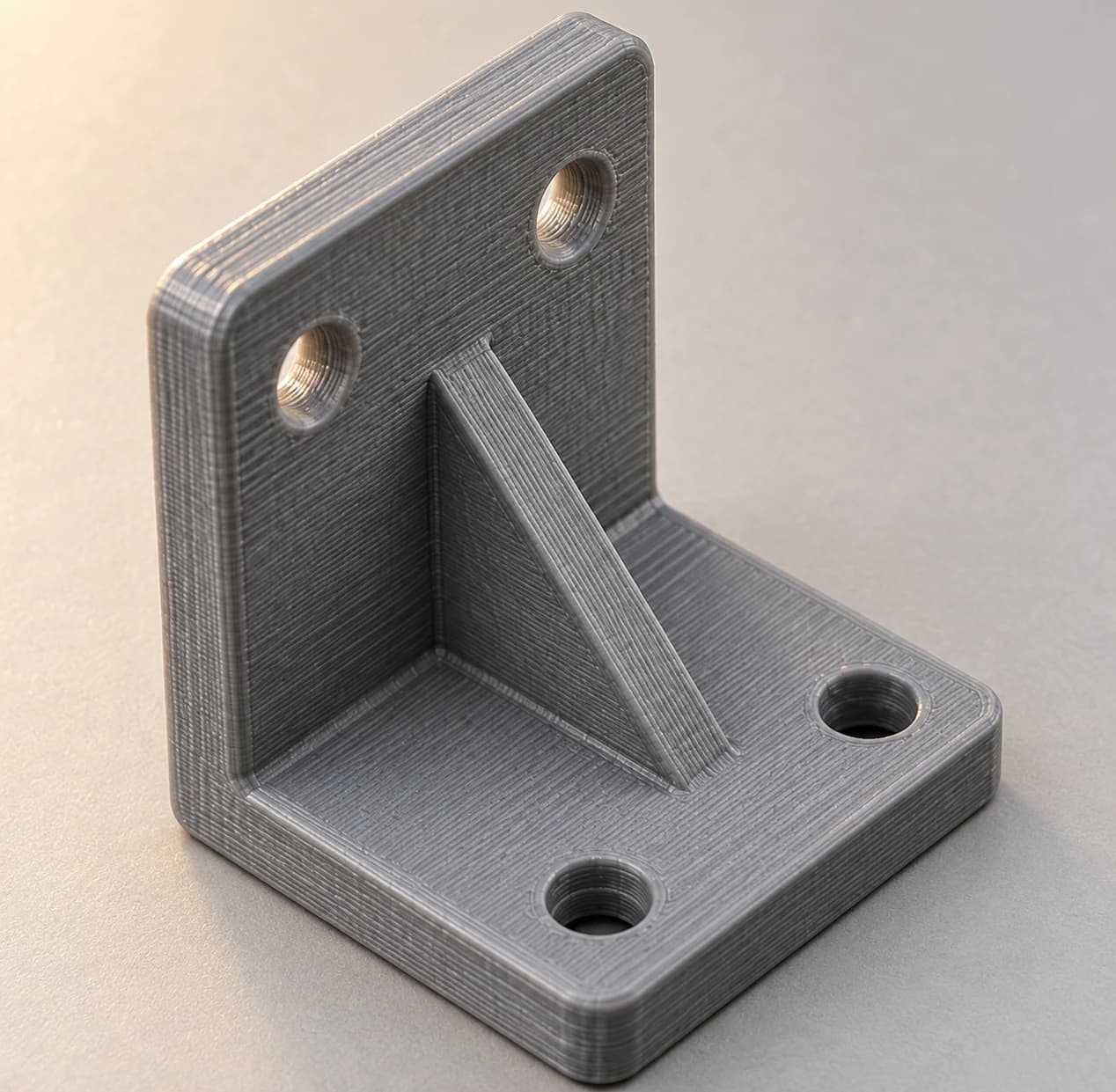
A gusset is the little triangle between the two legs of an angle bracket. It stops the corner from opening up under load. One gusset on each side is often enough. It adds a few grams and a lot of stiffness.
Sharp inside corners crack first. A small fillet spreads the load across more plastic. Walls under about 1.6 mm get flagged when you upload. Use 3 mm on a mount that carries weight. All seven upload checks are listed on our design checks page.
Spread the load over more than one bolt. Two bolts near each other put all the stress in one place. Move them apart and the bracket holds far more.
Bolt holes, inserts, and slots
Leave a clearance hole, not a tight one. Printed holes come out a little small, so a hole drawn at bolt size will fight the bolt. Tell us the hardware you use and we size the holes to fit. Nothing gets drilled on your side.
Add a flat face where the bolt head or washer lands. A washer on a curved or rough face digs in and works loose. A flat pad keeps the clamp force even.
For threads, use a brass heat-set insert. Brass takes far more screw cycles than plastic. We can set them for you, as a line on a reviewed quote. A captive nut pocket works too. It is a six-sided slot that traps a nut inside the print. The bolt then pulls against metal, not plastic.
Slots beat round holes when a mount needs to move. A slot gives you a few millimeters of adjustment after the bracket is on the wall. Add a small slot for a zip tie and the cable rides with the mount.
What a bracket order looks like
These examples show typical jobs, not named customers.
A machine builder orders 40 PETG sensor mounts. They print one, check the bolt spacing on the line, then release the rest.
A robotics team orders mounts twice a year. The file sits in their account, so each reorder takes three clicks. See robotics parts for that kind of work.
You see one price per part. That per-part price drops as you order more, because copies share a print plate. Your instant price holds for 30 days, so a PO has time to clear. A reviewed PA-CF quote shows its own valid-until date. Check how our pricing works, or upload a file at the instant quote to see a real number.
Most orders ship in 3 to 5 business days. We print and ship in the USA, so customs never holds your parts.
When to use metal instead
Some mounts should be metal. Go metal if the bracket holds a person. Go metal if a heavy load hangs over a walkway. Go metal past the heat any of our plastics can take, even PA-CF, our top heat pick. Those jobs are past what any plastic here can do.
Plastic wins on speed, price, and shape. A printed mount can be an odd shape at no extra cost. It ships in days. It changes for free when the design moves.
Many teams use both. They print the mount while the design is moving, then decide later if it ever needs to be metal. Need a box to go with the mount? See custom enclosures. Need shop tooling? See jigs and fixtures.
Common questions
- Are 3D printed brackets strong enough to bear load?
- Yes, when the design fits the process. Print the bracket flat so the load runs along the layers. Add a gusset at the corner. Keep walls at 3 mm on a mount that carries weight. PA-CF is the pick for heavy or repeated load.
- What material should I use for a mounting bracket?
- Use PETG for most mounts. It holds its shape well in normal heat and bends a little before it breaks. Pick ABS when the mount sits near real heat, since it ranks just behind PA-CF there. Pick PA-CF when the mount carries real load, since it holds the most heat we print.
- Will layer lines weaken a 3D printed bracket?
- Mostly in one direction. The bond between layers is usually weaker than the layers themselves, so a load that peels the layers apart is the usual risk. The size of that difference varies widely by material and machine. Tell us where the load goes and we turn the part so the layers fight it. That choice is free and it makes a large difference.
- Can you put metal threads in a printed bracket?
- Yes. We can press brass heat-set inserts into the print, which shows up as its own line on a reviewed quote. Brass takes far more screw cycles than plastic threads. A captive nut pocket is another option. A nut is trapped inside the part, so the bolt pulls against metal.
- Can I order a single bracket to test the fit?
- Yes. There is no minimum order. Order one, check it against the real part, then order the run from the same file. The per-part price drops as you order more, because copies share a print plate and the file check and packing happen once per order.
- How long do 3D printed brackets take to arrive?
- Most orders ship in 3 to 5 business days. PLA, PETG, PETG-CF and OPM mounts get an instant price the moment you upload. ABS, PA-CF, and TPU route to a person. A person reviews your request and follows up by email.
See your price in the next 60 seconds.
Upload your STL. Made in the USA, shipped in days.